Pages

Friday, 9 August 2013

British Airways jet forced to make TWO emergency landings in 24 hours

BA


Passengers had screamed and been physically sick as the Heathrow-bound Boeing 747 had to turn round and make an emergency landing (right) and dump 20 tonnes of fuel (left) at King Khalid International in Saudi Arabia shortly after take-off when its wing flaps jammed.

Astonishingly, when they boarded the same plane yesterday the same problem occurred and they had to return to the capital Riyadh again.

In the terminal there was 'mayhem' (centre) as just one BA worker tried to deal with more than 300 furious passengers who staged a sit-in while other ground crew 'hid' in a back office, said passenger Dean Jones. 'Fights broke out and the military turned up,' he added.

The sit-in organiser, who remained anonymous, said: ‘It was extremely hot but we had to make a stand. But nobody came to speak to us.’

Last night BA apologised and said a replacement plane should arrive this morning. It said it was offering passengers compensation, expenses and complimentary tickets, and had arranged hotel accommodation for them.


Source

Woman commits suicide four months after giving birth to twins

Muji, the twins and the well


Punch - A nursing mother has committed suicide, four months after giving birth to a set of twins, on Oremerin Street, Ladilak, Somolu, Lagos State.

The woman, Mrs. Muji Kazeem, a hairdresser, was found dead in a well on Tuesday morning. The well was located two houses to the apartment that Muji and her husband, Adewale, were staying.

Our correspondent, who visited the Kazeems, learnt that the twins came after five years of marriage.

Kazeem, 28, said his wife was found dead in the well two days after she was declared missing.

He said, “We were together on Sunday night having prayers around 9.30pm. Then, the babies started crying, so I told her to go and breast-feed them.

“By the time I finished praying, she had slept off with the twins on the bed. I spread a mat on the floor by the entrance and slept off.

“Muji woke up around 11.30pm and went outside. One of my friends told me that he saw her at that time taking cool air before he went inside to sleep.”

Kazeem said he was awaken by the wailing of the twins around 1am. He said he searched for their mother without success.

When the day broke, Kazeem raised the alarm that his wife was missing. The neighbourhood was said to have been thrown into confusion as a search party was organised to look for her without success. The matter was later reported at the Pedro Police Station.

Kazeem said, “We saw her clothes near the well on Monday night and became hopeful. We intensified prayers for her. But it was 7am the following day that a woman, who wanted to draw water from the well, observed that the drawer did not get water. She got a torchlight, pointed it down the well and saw the swollen corpse of my wife.”

He said Muji had been buried at the Atan Cemetry at Yaba in line with Islamic rites.

“We buried her at the Atan Cemetery after obtaining police report. My mother has taken the babies for care,” he said.

Kazeem described his late wife as a gentle and cheerful woman, who never fought or quarrelled with anyone since he met her.

He said, “We have never had any reason to fight or disagree. I don’t know if she offended anyone who decided not to forgive her. But for me, I have taken this as my destiny.”

However, PUNCH Metro learnt that the deceased had been depressed a few days before her death.

A source within the area, said the 25-year-old mother, could sometimes be lost in thought for several hours and would not respond to greetings until people shouted at her.

The state Police Public Relations Officer, Ngozi Braide, promised to get back to the Punch correspondent when she was contacted on the telephone.

Wednesday, 7 August 2013

Chris Brown: I'm Quitting Music!

Chris Brown

Chris Brown took to Twitter on Tuesday to tell the world that he plans to quit music after the release of "X," his upcoming LP.
The R&B singer said he's "tired of being famous for a mistake" he made when he was 18, referencing when he assaulted Rihanna.
Both Brown, who has had a string of other post-assault altercations and incidents on his rap sheet, and the music industry, which has promoted and booked Brown since shortly after the assault, have faced near constant criticism since the horrific event that took place before the 2009 Grammys.

Chris Brown
Don't worry mainstream America.After this X album, it'll probably be my last album.


Chris Brown
Being famous is amazing when it's for ur music and talent. I'm tired of being famous for a mistake I made when i was 18. I'm cool & over it!

Brown's tweets have been littered with inspirational messages as of late. "I'm not a performer nor do I have to be," he said in one tweet. "We are all children pretending to be gods!"
"Aspire to be great and the person you wanna be," he wrote in another. "Don't conform because [your] worth is more than any money or status. We live. We die."
"X," Brown's sixth studio album, is out in stores on Aug. 20. It's worth noting that plenty of other performers have claimed they were retiring before, including Jay Z, who returned in 2006 following a three-year hiatus that he later admitted was "the worst retirement in history."


#huffingtonpost

'Tribe of Ghosts': Inside the centre where Tanzania's outcast albinos find refuge from murderers who kill them for their body parts

  • Kabanaga Protectorate Centre in Kabanga is home to more than 70 albinos
  • Most were driven from their communities as outcasts or fled in fear for lives
  • In parts of Africa, albinos are butchered for their body parts for potions
  • There is a belief they are the product of witchcraft or affairs with white men
  • Associated Press staff photojournalist Jacquelyn Martin visited the centre and met its members
  • She says: 'The children break your heart - they are uniquely beautiful people'

The Kabanaga Protectorate Centre in the town of Kabanaga in the north-west of the East African country, close to the Burundi border, caters to the nation's albinos, who are known as the 'tribe of ghosts', 'zeros' or 'the invisibles'.

They have suffered appalling treatment at the hands of their own neighbours and are murdered for their body parts, which are believed to bring good fortune and cure all manner of ills.
 

Surrogate: Lightness Philbert, who doesn't know her age and was abandoned at the Kabanga Protectorate Center, in Kabanga, Tanzania, nurses a baby who was brought by there by her mother
 

Bright future: Yonge, four, closes her eyes against the bright sunlight. Albinism also affects her eyes with light sensitivity and low vision. The child was abandoned by her parents

Associated Press staff photojournalist Jacquelyn Martin, based in Washington in the U.S, visited the centre to chronicle those who are treated with fear and contempt for a simple genetic fluke.

'The children break your heart,' says Jacquelyn, who travelled to the centre as part of the personal project. 'Especially the ones who have been abandoned - They are uniquely beautiful people.'

The 70-or-so albinos, who range in age from newborns to sexagenarians, are at the centre for a combination of factors.

Sometimes the parents are afraid of their children, sometimes they are forced to give up their beloved offspring because they fear the prejudices of the people in their own community.

'Despite everything they've been through and what they are probably going to have to face in the future,' says Jacquelyn. 'They really wanted to go back to their villages and live a normal life.

'There's a sense of community in the centre, where older people take care of the babies and younger children.'


Joy in the face of prejudice: Girls chatter playfully by a small store just outside the gates of the Kabanga Protectorate Center


Epifania 'Happiness' Ezra, 16, poses for a portrait in Matiazo Village, Tanzania. She has only ever met one other person with albinism in her life

MURDERED FOR THEIR HAIR, BONES AND GENITALS: THE HORRIFYING PLIGHT OF ALBINOS IN TANZANIA:


Albinism is a genetic condition characterised by a deficiency of melanin pigmentation in the skin, hair and eyes which protects from the sun's ultraviolet rays.

In many African nations - but most commonly in Tanzania - albinos are butchered in the street.

Their remains are used in the macabre human potions used by traditional healers to treat the sick

Believing it will bring them good luck and big catches, fishermen on the shores Lake Victoria weave albino hair into nets.

Bones are ground down and buried in the earth by miners, who believe they will be transformed into diamonds.

The genitals are also sometimes made into treatments to boost sexual potency.

One of the albinos is 17-year-old Angel, who was visited by her mother from a remote and poor part of the country for the first time in four years.


When she was born her father called her 'a gift from God'.


But his joy was not that of a new father - he wanted to butcher the girl and sell her body parts for thousands of dollars, a fortune to the average family in Tanzania

Angel's mother was filled with love for her daughter and managed to deter the father for years, but when Angel was 13 he led a group to attack her.


Angel got away, but her mother's own parents were killed in the attack as they fought to protect their granddaughter.

But Jacquelyn says she will never escape the prejudice that follows her wherever she goes.


'There's a market close to the centre and the women went together in a group as a safety measure because it's harder to kidnap someone in a group,' says Jacquelyn. 'Angel was in a shop and the woman behind the counter couldn't look her in the eyes.


'She just took her money. That was something that struck me.'


Ignorance about the condition is rife - there is even a belief that their mothers slept with white men to give them the condition.

'Sometimes it's less about beliefs than pure economics,' says Jacquelyn. '[But] there was this note of strength in all of the ones I met; all of them had hopes for something greater.'

'One wanted to be a politician to help other albinos, another wanted to be a lawyer to fight for their rights, one wanted to be a teacher to educate people about the condition and another wanted to be a journalist to report about people with albinism.'

But it is a long and steep slope to climb before Tanzania truly wakes up to the terrible plight that faces each albino born into this world.

In February attackers collecting body parts of albinos for witchcraft hacked off the hand of a seven-year-old boy, officials said.

The boy, called Mwigulu Magessa, was ambushed by the men as he walked home with his friends in Tanzania. He survived but many such victims of ignorance are not so lucky.


Just days earlier an albino mother of four had her arm chopped off by machete-wielding men and a month before that an albino child died in Tanzania's Tabora region after attackers hacked off his arm.'


Tribe of ghosts: Eumen Ezekiel, 13, was attacked in 2007 and hasn't seen his mother since. 'I want to be a member of parliament and defend others living with albinism,' he said


Zainab, 12, left, stands in a doorway at the Kabanga Protectorate Center, in Kabanga, Tanzania. Zainab and other children and adults have been placed in centres to protect them from being hunted for their body parts


There is very little being done by the government other than putting them in centres to ensure their safety,' Jacquelyn adds. 'They are just sweeping them under the rug, there isn't a long-term solution.

'It was hard to leave the children in this situation and I hope my photography has put a human face on the issue and I hope they see themselves as I see them - beautiful people who deserve a chance in life.'

Jacquelyn collaborated with the non-profit organisation Asante Mariamu during her trip to the centre, which is housed in the Kabanga Primary School, a government boarding school for disabled children.

The organisation is dedicated to raising awareness about the ongoing human rights crisis impacting people with albinism in East Africa.

They seek to teach people with albinism about the condition, so that they can better understand how to protect themselves from skin cancer.

They also work to dispel the myths surrounding the condition to increase acceptance in society.

Providing direct relief with sun protective gear and sunscreen, Asante Mariamu also seeks to empower people with albinism by providing opportunities for education so that they can become vital and valuable members of society.
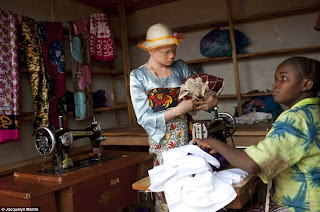


Angel Salvatory, 17, who has skin cancer, buys cloth at the Kabanga Village market in Kabanga, Tanzania on Monday. The photographer says the woman serving her would not look Angel in the eye


Tuesday, 6 August 2013

VIDEO: Michelle Obama Hip Hop Album set to be released on September 30th.... First Lady Fights Obesity Through Music


A hip hop album by Michelle Obama? Yet another example of the expanding influence and impact of the music.

Just a few weeks ago, Nas was honored with a hip hop fellowship in his name at Harvard University. Teachers are using hip hop in their classrooms to get students interested in math and science, and now the first lady, Michelle Obama is utilizing hip hop as a platform to educate and influence young people.

Her “Let’s Move!” program plans to release a hip hop album complete with 19 songs and 10 music videos in conjunction with the Partnership for a Healthier America and Hip Hop Public Health.

The album, set to be released on September 30th features artists including Run DMC, Ashanti, Doug E. Fresh and Jordin Sparks. The video above, called “Everybody” was released in June and features an appearance from the First Lady and Dr. Oz.

The rest of the videos will be distributed across the country beginning with 40 schools in New York City and expanding to other major cities, according to US News And World Reports.

"Throughout history, music has been a great teacher and motivator, from ABC’s and nursery rhymes to religious hymns and national anthems. It is time to harness this power for health,” explained Founder of Hip Hop Public Health Dr. Olajide Williams.

The directors of the project are looking to create a strong resonance within the African American community. Close to 50 percent of African American children are overweight, according to a 2011 National Healthcare Disparities Report.

"Cultural leaders and visionaries in our country can give these messages to kids in a way that's not preachy. Kids are going to be dancing and listening to the music,"Let's Move! Executive Director and White House assistant chef, Sam Kass explained. "I think hip hop in particular – so many kids love hip hop. It's such a core part of our culture ...and particularly in the African-American community and the Latino community which is being disproportionately affected by those health issues."


CLICK LINK TO WATCH


#huffingtonpost